


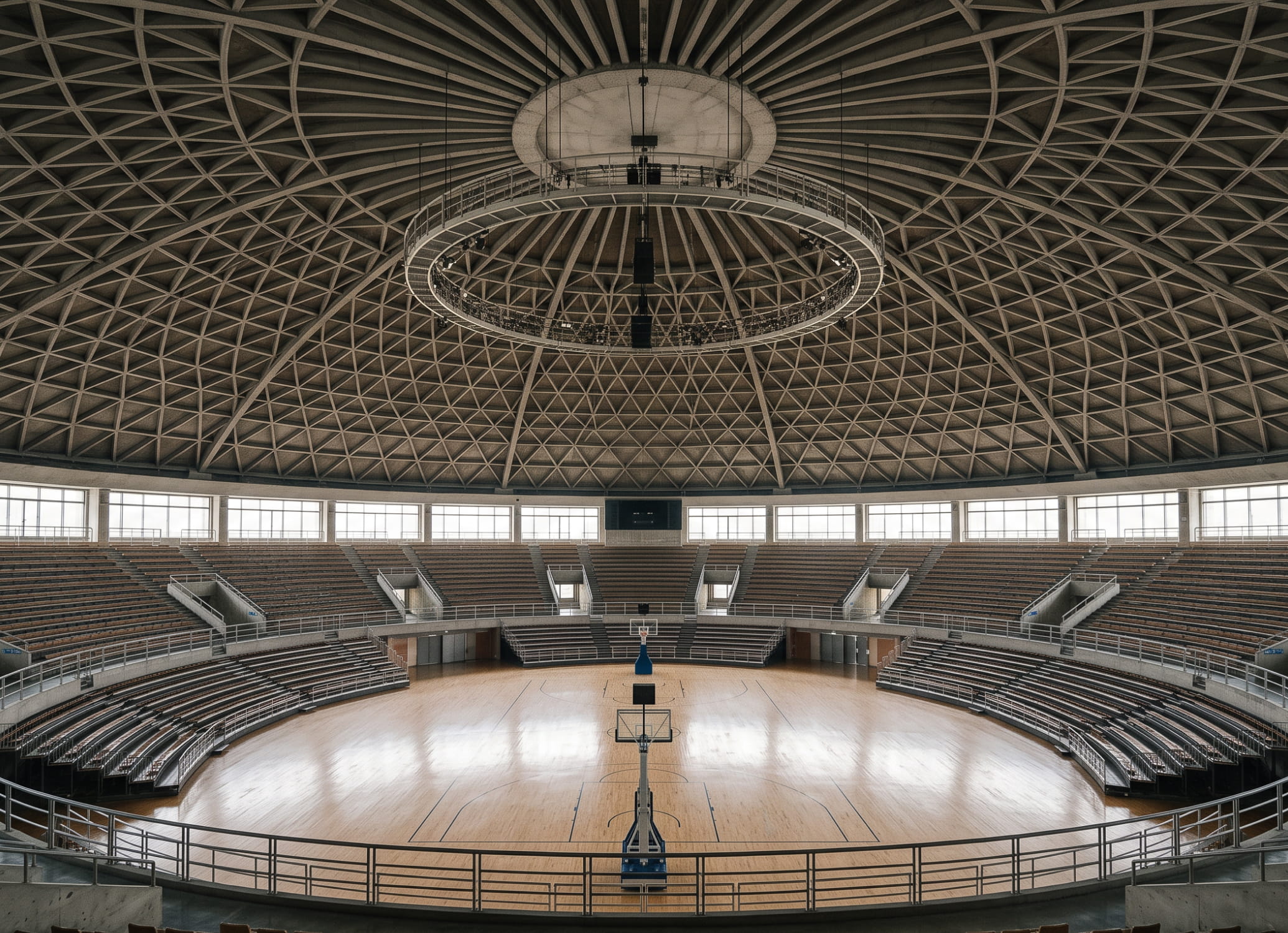
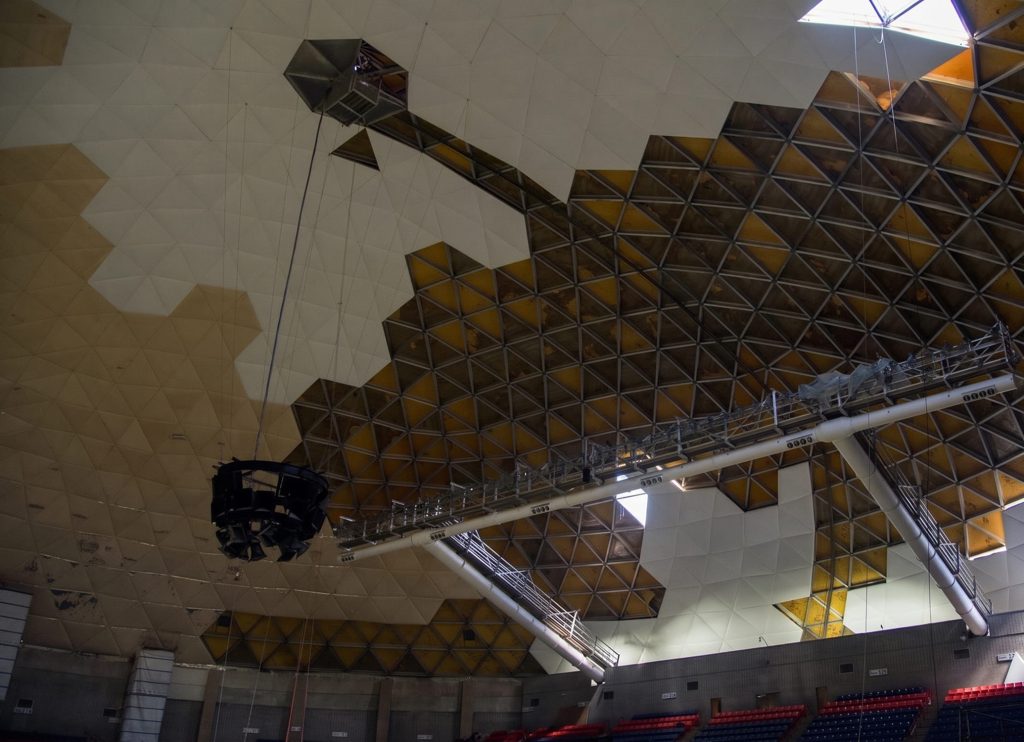
For a team renovating a sports arena, the work overhead presented an unusual challenge: the dome’s old fiberglass ceiling insulation was failing, and replacing it meant taking large sections of the structure down to ground level.
The dome was an existing structure, with a shape and assembly method the renovation team had to work around. Failing insulation made replacement necessary, while its construction made access difficult. That combination set the direction of the project. The new insulation needed a credible route onto the panels, including what would happen while they were at ground level and how they would be returned to their place above the court.
Our work with the specialist contractor and project representative centered on making that operation manageable. The material had to suit the dome, the bonding method and the sequence of work on site.
Challenge
Large panels had to be craned off the dome, brought down, cleaned and fitted with new insulation before going back into place. Access was difficult. The team needed a workable method before committing to a demanding installation sequence.
The foam’s low weight mattered, as did the ability to bond it without piercing the dome panels. Large sections would help minimize seams, but they also required special handling and transport. Material choice, adhesive and delivery all had to be considered together.
The project team described the operation as having one opportunity to get it right. A panel lowered by crane is a substantial piece of work waiting to be completed and returned. Questions about surface preparation, layout or adhesive could not simply be left until the installers encountered them. The method needed to be worked through in advance, at the scale of the real panel and with its actual surfaces available to inspect.
Solution
Start with the panels on site
We visited the arena to examine the panels and work through mock-ups. Seeing the actual surfaces and geometry allowed the team to address the installation at the scale at which it would happen.
From there, we developed a custom adhesive solution for the project’s demanding requirements and guided the team through layout, surface preparation and installation techniques. The purpose was to make the method clear before the full sequence was under way.
Mock-ups made the conversation more concrete. A drawing can show the intended arrangement, but the actual panel lets people examine how the material will meet its surface. We walked the team through preparation and installation techniques in that setting. The support covered the practical transition between removing the old insulation and fitting the replacement, helping the installers understand how to approach the work before repeating it across the dome.
The adhesive was central to that route. The foam had been chosen partly because it could be bonded without piercing the dome panels. A custom adhesive solution therefore belonged to the design of the installation, alongside the low weight of the foam. Both choices responded to the same physical situation: a large structural panel that had to receive a new layer of insulation before being lifted back into place.
Make the material suit the geometry
We arranged oversized foam buns, transported in special containers. These larger sections helped limit the number of seams across the panels.
That decision connected a detail in the finished ceiling to the way the material was supplied. The size needed on site determined what had to be prepared and shipped.
Minimizing seams was a reason to reconsider the starting format of the material. Supplying more manageable small pieces would still leave the installer with more joins to make across a large panel. The oversized buns offered another route: begin with enough foam to make larger sections. That choice had consequences beyond the finished surface, so special containers became part of the supply plan. Product dimensions and transport had to be worked out together.
Keep supply moving with the work
Material was delivered in multiple truckloads as the site needed it. Our project account reports turnaround times of less than a week.
Supply was part of the installation plan. The team needed material to arrive in step with panels being lowered, prepared and returned to the dome, so responsiveness mattered alongside the insulation itself.
A renovation like this progresses through physical stages. Material is useful when the site is ready to prepare and fit it, and the panel sequence determines how that need develops. Delivering as required kept us involved beyond the initial order. Repeated deliveries and reported turnaround of less than a week supported the work taking place at the arena.
Make support useful at the point of installation
For this project, support was most valuable where the material met the building. Examining the panels, making mock-ups, explaining preparation and arranging the large foam sections all served that point of contact. The case shows how a supplier can contribute to a renovation by working through the physical steps with the people responsible for carrying them out.
The different decisions are closely related. The choice to bond without piercing the panels makes the adhesive important. The decision to minimize seams affects the material format. The panel-removal sequence makes responsive deliveries useful. Seen together, these are the details of one installation method, developed around an existing structure and a difficult access problem.
Results
At the time of the project account, the renovation was ongoing. Our project team reported that installation had gone smoothly, with no installation problems raised with Pinta.
For a job involving large panels, crane movements and a difficult roof geometry, that is a meaningful point of progress. The work so far brings together a practical bonding method, material sized for the task and close support for the people carrying it out.
The intended long-term benefit was a renewed ceiling that could serve the arena for years. At the time of the account, the encouraging result was how the installation had progressed. The team had been able to carry out a complicated operation without bringing installation problems back to Pinta. This describes progress during the work, rather than confirmation that the wider renovation is complete.
Need insulation for a challenging renovation?
Talk through your project